


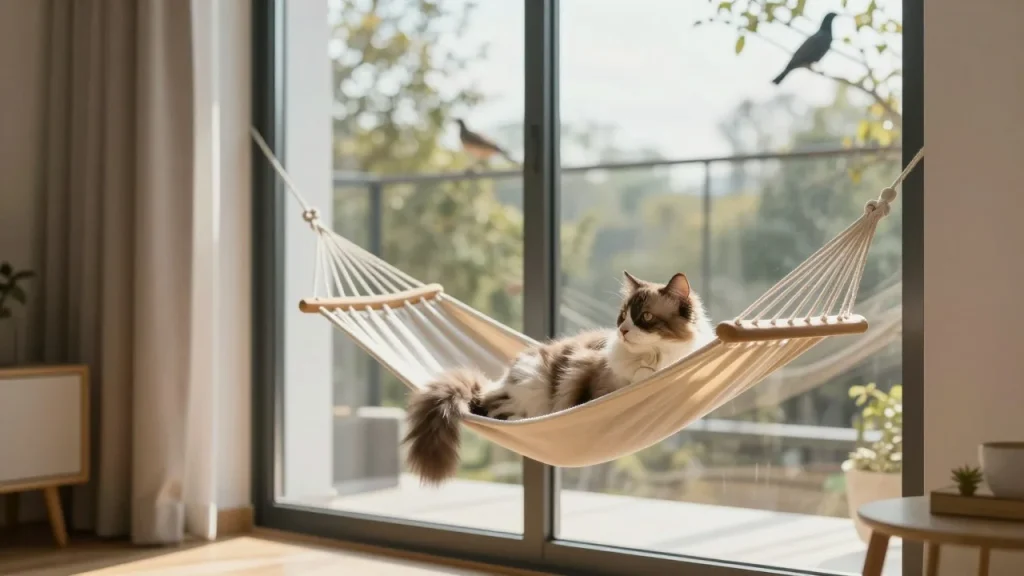
A sunny window can be one of the most interesting places in the house for an indoor cat, but a narrow windowsill does not always provide enough room to settle comfortably. A cat window hammock creates an elevated resting spot where a cat can nap, watch birds, follow neighborhood activity, and enjoy the warmth of the sun without taking up valuable floor space. The challenge is choosing a design that fits both your cat and your particular window instead of buying the first perch with impressive-looking suction cups.
Quick answer: A cat window hammock is a window-mounted perch that gives an indoor cat an elevated place to nap, sunbathe, and watch outdoor activity. The best choice fits the available glass or sill, comfortably supports your cat’s weight, provides a stable resting surface, and uses a mounting system appropriate for your window.
What Is a Cat Window Hammock?
A window hammock for cats is a raised bed or platform positioned directly beside a window, usually with suction cups, sill brackets, clamps, or another no-floor-space mounting system. Some versions use flexible fabric that forms a true hammock, while others have rigid metal, plastic, or wood frames topped with mesh, fleece, or removable cushions. You may also see the same products described as a cat window perch, cat window bed, window-mounted cat seat, or suction cup cat hammock.
The attraction is not just the warm patch of sunlight. Ohio State University’s Indoor Pet Initiative explains that cats benefit from elevated perches where they can observe their surroundings, and it specifically recommends providing opportunities to look outside from a secure raised location. A window hammock combines that vertical vantage point with outdoor sights and sounds, making it a practical form of environmental enrichment for many indoor cats.
Why Do Cats Like Window Hammocks So Much?
Cats naturally seek places that give them a clear view while keeping them above much of the activity happening at floor level. A window perch can become a quiet observation post where a cat sees birds, squirrels, passing people, leaves, and changing daylight without actually going outdoors. For a cat that already spends time balancing on a narrow sill or the back of a sofa, a wider dedicated platform can also provide a more comfortable place to stretch out.
Window access can be particularly valuable for indoor-only cats because it adds variety to an otherwise predictable environment. Ohio State advises providing indoor cats with perches near windows and notes that elevated spaces can help them observe their surroundings from a position where they feel secure. A hammock will not replace interactive play, scratching opportunities, hiding places, or social interaction, but it can become one useful part of a richer indoor environment.
Main Types of Window Hammocks
| Type | How it mounts | Best for | Main consideration |
|---|---|---|---|
| Suction-cup hammock | Large suction cups attach to smooth glass | Renters, apartments, tool-free installation | Suction seals need regular inspection |
| Rigid suction-cup perch | Suction cups support a firm framed platform | Cats that dislike a sagging fabric bed | Requires enough clear glass for the cups |
| Sill-mounted perch | Brackets or clamps grip the windowsill | Larger cats or unsuitable glass | Requires a compatible sill |
| Foldable window hammock | Suction or bracket mounting with a folding deck | Windows with curtains or blinds | Hinges and supports should lock securely |
| Double-level perch | Multiple platforms arranged vertically | Multi-cat homes or climbing cats | Total potential load and window size matter |
There is no single mounting style that is automatically best for every home. Current window-perch guides consistently distinguish between suction-mounted designs for smooth glass and sill or clamp designs for windows where suction mounting is less practical. Your window construction should therefore determine the mounting system before color, fabric, or appearance becomes part of the decision.
7 Things to Check Before You Buy
1. Match the Mount to Your Window
Start by looking at the window rather than the hammock. Suction cups require a smooth, nonporous surface with enough uninterrupted glass for every cup to sit flat, while textured panes, divided glass, unusual frames, or very narrow windows may make a sill-mounted model more suitable. Never assume that a product shown on a large picture window will fit a smaller apartment window without measuring the mounting area first.
2. Choose a Weight Rating With Room to Spare
Check the manufacturer’s stated capacity and compare it with the weight of every cat that could realistically climb onto the perch. A cat jumping onto a platform creates more movement than the same cat lying still, so buying right at the stated limit leaves little practical margin for active use. In multi-cat homes, consider the combined weight if two cats could decide to share the hammock at the same time rather than assuming they will use it separately.
3. Measure the Resting Surface as Well as the Glass
A hammock can fit the window and still be too small for the cat. Measure the usable platform dimensions and compare them with the space your cat occupies when lying comfortably, especially if you have a long-bodied or large-breed cat. Also check the full assembled height and width because support cables and upper suction cups can require substantially more window area than the bed itself.
4. Look at the Frame, Not Just the Fabric
Soft fleece and cute patterns may attract attention on a product page, but the support structure determines how stable the perch feels under a moving cat. Look for a frame that stays level, attachment points that do not twist easily, and connectors designed to remain secure when the cat climbs on and off. Cats that dislike swinging or sagging surfaces may be happier on a rigid platform even if a fabric hammock looks more comfortable to a human.
5. Choose a Surface Your Cat Will Actually Enjoy
Mesh surfaces allow more airflow and can be useful beside a warm, sunny window, while fleece or padded covers may feel cozier during cooler months. Removable, washable covers make routine cleaning easier because window beds collect fur, dust, and the occasional muddy paw print just like other pet furniture. A reversible design can be especially practical if your home experiences hot summers and cold winters.
6. Think About How Your Cat Gets On and Off
Healthy young cats may leap onto a high perch without hesitation, but seniors, kittens, overweight cats, and cats with mobility limitations may need a lower approach. Positioning a stable chair, cat tree platform, or other intermediate step nearby can reduce the height of each jump and make the hammock easier to use. If your cat repeatedly struggles to reach a particular window, moving the perch is usually more useful than repeatedly placing the cat on it.
7. Consider Cleaning, Curtains, and Daily Life
A window hammock should work with the room rather than becoming something you remove every evening. Foldable designs can help when you regularly close curtains or blinds, while removable fabric makes fur cleanup simpler and reduces the temptation to ignore a dirty bed. Before ordering, check whether the assembled perch blocks window locks, handles, shades, vents, or anything else you use routinely.
How to Install a Suction-Cup Window Hammock Safely
Correct installation matters as much as the product itself because even a strong suction cup cannot compensate for dirty glass, an incomplete seal, or incorrect assembly. Read the manufacturer’s directions first because cup preparation and frame assembly can vary from one design to another. Install the hammock before your cat is in the room if possible, which gives you time to check the setup without an impatient cat attempting the first test jump.
- Choose smooth, intact glass. Avoid mounting on cracked, heavily textured, dirty, or otherwise unsuitable surfaces unless the manufacturer specifically approves them.
- Clean the mounting area thoroughly. Remove dust, grease, fingerprints, and cleaner residue, then prepare the suction cups exactly as directed by the manufacturer.
- Assemble the frame completely. Confirm that rods, brackets, cables, covers, and connectors are positioned correctly before putting weight on the perch.
- Press each suction cup firmly into place. Make sure the cup sits flat and has formed a complete seal rather than gripping only around part of its edge.
- Check that the platform is level. Uneven supports can make the bed tilt when the cat steps onto one side.
- Test the installation gradually. Apply controlled pressure or follow the manufacturer’s recommended load-check procedure before allowing the cat to jump onto it.
- Inspect the mount regularly. Recheck the cups, hardware, fabric, cables, and frame whenever anything appears loose, stretched, cracked, or worn.
Clean glass is especially important for suction-mounted furniture, so it makes sense to include the window area in your normal household routine rather than waiting until the cups begin slipping. Writfy’s guide to the best order to clean your house efficiently recommends handling glass and surfaces systematically before finishing with floors, which is useful when pet fur and window cleaning are part of the same job. The key difference is that a hammock should be removed or secured according to its instructions before cleaning around its mounting points.
Are Suction-Cup Window Hammocks Safe?
A properly fitted suction-cup hammock can be a practical option when the glass, weight capacity, assembly, and ongoing maintenance all match the product instructions. The important word is properly, because suction seals can loosen and should not be treated as something that never needs another inspection after installation. Current cat-perch buying guides likewise recommend matching the mount to the window, respecting stated capacities, and checking suction systems routinely.
Watch for warning signs that mean the hammock should come out of service until the issue is corrected.
- A suction cup repeatedly releases from the glass.
- Cracks, stiffness, distortion, or deterioration in a cup.
- Bent frame pieces or loose connectors.
- Fraying cables, straps, seams, or fabric.
- A platform that suddenly tilts or shifts.
- A cat whose weight exceeds the stated capacity.
- Two cats using a perch that was selected for only one.
- Damage to the window or mounting surface.
A window hammock also does not make an open window safe. The ASPCA warns that cats can fall from unscreened windows and recommends snug, sturdy screens, noting that ordinary childproof window guards are not sufficient protection for pets. If the hammock sits beside a window that opens, treat secure screening as a separate safety requirement rather than assuming the perch itself will prevent a fall.
Suction-Cup Hammock vs. Sill-Mounted Perch
| Feature | Suction-cup hammock | Sill-mounted perch |
|---|---|---|
| Drilling usually required | No | Often no, depending on design |
| Best mounting surface | Smooth glass | Compatible windowsill or frame |
| Easy to move | Usually | Depends on clamp or bracket |
| Works on textured glass | Usually not | Often a better option |
| Visual footprint | Can be very minimal | May use more sill space |
| Maintenance priority | Suction seals and cups | Clamps, brackets, and sill fit |
| Good renter option | Often | Often, when no screws are required |
A suction design makes sense when you have large, smooth panes and want a perch that leaves the floor and sill largely unobstructed. A sill-mounted model may be preferable when the glass is divided, textured, too small for the cup arrangement, or simply not a surface you want to rely on. Choose based on compatibility rather than trying to make an unsuitable mounting style work through improvised adhesives, extra hardware, or modifications the manufacturer never approved.
Where Should You Put a Window Perch?
The most attractive location is usually a window your cat already visits. A quiet living-room or bedroom window with outdoor activity can be more appealing than a theoretically perfect sunny window in a room the cat rarely enters, so observe existing habits before choosing a location. Avoid creating a setup where the cat must squeeze behind fragile decor, cross a slippery surface, or jump through dangling blind cords to reach the bed.
Sun exposure also changes through the day and across the seasons. A south- or west-facing U.S. window can become surprisingly warm during sunny periods, so make sure the cat can freely leave the perch and move to a cooler location whenever it wants. The hammock should offer another choice within the home rather than becoming the cat’s only comfortable elevated resting place.
How to Encourage a Cat to Use a New Window Hammock
Some cats investigate new furniture immediately, while others treat it as suspicious for several days. Put the hammock near a window the cat already likes, give it time to become familiar, and make the surface inviting with a familiar blanket or a few treats if doing so does not interfere with the mounting system. Ohio State recommends allowing cats to approach new perch areas voluntarily and using positive associations rather than forcing them to remain there.
Avoid repeatedly picking up a reluctant cat and placing it on the hammock. That can make a cautious cat associate the new perch with being handled or trapped instead of with rest and observation. If the cat consistently ignores it, reconsider the height, stability, temperature, view, fabric, or access route before concluding that the cat simply does not like window beds.
Is a Window Hammock Worth It?
For an indoor cat that already enjoys windows and elevated resting spots, a well-chosen hammock can provide a large amount of usable territory without occupying floor space. That makes it particularly attractive in apartments, smaller U.S. homes, and rooms where a full cat tree would be difficult to place. It is also one of the few pieces of cat furniture that can combine sleeping space, vertical territory, sunlight, and visual enrichment in one compact location.
It is less useful when the available windows are unsuitable for mounting or when a cat has difficulty reaching elevated furniture. In those cases, a freestanding cat tree, padded bench, sturdy table, or purpose-built sill platform beside the window can provide much of the same benefit without relying on suction cups. The goal is not to own a particular accessory but to give the cat a stable, comfortable place from which to rest and observe.
The Bottom Line
A cat window hammock can turn unused window space into one of the most appealing resting areas in an indoor cat’s environment, but successful setups begin with fit and stability rather than appearance. Choose a mount that suits the window, select capacity and dimensions for the actual cat or cats using it, provide easy access, and inspect the installation routinely. When those basics are handled well, the result can be a compact perch that gives your cat a comfortable front-row seat to the world outside.
Frequently Asked Questions
Do window hammocks really stay up?
Good-quality window hammocks can remain securely mounted when they are installed on compatible surfaces and used within the manufacturer’s stated limits. Their reliability still depends on correct assembly, clean mounting surfaces, intact suction cups or brackets, and regular inspection. A hammock that repeatedly slips should be removed and investigated instead of being pressed back onto the glass indefinitely.
How much weight can a cat window hammock hold?
Weight capacity varies significantly between products, so there is no universal safe number that covers every model. Current U.S.-market window perches are sold with different capacities and mounting systems, making the manufacturer’s rating for the exact model more useful than a generic rule found online. If multiple cats can access the perch, select for the possible combined load rather than the weight of the smallest or most frequent user.
Can a large cat use a window hammock?
Yes, provided the hammock has enough usable surface area, a suitable mounting system, and a capacity comfortably above the cat’s weight. Large cats may also prefer rigid platforms because they provide more predictable support than narrow or deeply sagging fabric hammocks. Measure the cat and the available window area before buying instead of relying on product photos featuring smaller animals.
Will suction cups damage a window?
Suction cups generally attach without drilling or permanent adhesive, which is one reason these hammocks are popular with renters. You should still follow the manufacturer’s instructions and avoid attaching anything to damaged or unsuitable glass. Check lease rules separately if you are considering a sill-mounted design that requires screws or permanent alterations.
Can two cats share one window hammock?
They can only do so when the perch is designed and rated for the combined load and provides enough physical space for both cats. Even when you intend it for one cat, assume another household cat may eventually climb onto it if both have access to the room. Multi-cat homes may be better served by a double-level perch or multiple separate window spots when individual cats prefer their own resting space.
How often should I check the suction cups?
There is no single maintenance interval that replaces the instructions supplied with a particular hammock. A practical habit is to visually and physically check the mounting system frequently, as well as after cleaning, moving the perch, large temperature changes, or any unexplained shift in the platform. Replace worn components rather than waiting for a partial failure to become a complete one.
