

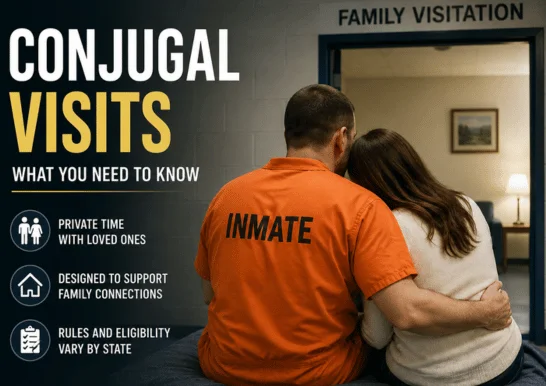
A conjugal visit is a private prison visit that allows an eligible incarcerated person to spend extended time with an approved spouse, partner, or family member. Intimacy may be possible, but modern programs often focus on maintaining family relationships and preparing incarcerated people for life after release. Rules vary by correctional system.
In the United States, these programs are not available in federal prisons. Some state prison systems offer similar visits under names such as “family visits,” “extended family visits,” or “family reunion programs.” California, for example, describes family visits as stays in private, apartment-like facilities. New York uses private, home-like settings for its Family Reunion Program.
| conjugal visit | What to know |
| Main purpose | Private time that can help families maintain close relationships |
| Common names | Family visit, Extended Family Visit, Family Reunion Program |
| Typical setting | A private or home-like area on correctional property |
| Eligibility | Depends on security status, conduct, relationship, facility, and local rules |
| Federal prisons | The Federal Bureau of Prisons does not permit these visits. |
| State prisons | Rules vary by state and can change. |
| Visit length | May range from several hours to overnight stays, depending on the program |
Key Takeaways
Private family visitation is not a universal benefit in U.S. prisons. The word “conjugal” can also be misleading because some current programs include children, parents, and other close relatives. Federal prisons prohibit this type of visit, while some state prison systems maintain their own family visitation programs. Always check with the responsible corrections department before making plans.
What Is a Conjugal Visit?

The traditional term usually refers to extended private time between an incarcerated person and a spouse or partner. Popular culture often presents these visits mainly as opportunities for sexual intimacy. That description does not fully reflect how many current correctional agencies describe their programs.
California allows eligible incarcerated people to receive visits from certain immediate family members. These may include legal spouses, registered domestic partners, parents, children, siblings, and verified foster relatives. New York also allows several types of relatives to participate in its Family Reunion Program. This broader approach explains why many agencies prefer terms centered on family visitation rather than marital intimacy.
What Happens During a Private Family Visit?
The experience depends on the prison and jurisdiction. These visits are usually more private and longer than ordinary visiting-room meetings. California’s program offers a useful example. Eligible family visits take place in apartment-like facilities on prison grounds and generally last about 30 to 40 hours. The incarcerated person must apply through the institution, and scheduling depends partly on availability.
California also requires families to pay for their meals, while other accommodations are provided without charge. Visits may be scheduled on weekdays, weekends, or both, depending on the institution. New York describes its program area as a private, home-like setting. This arrangement reflects the broader goal of giving families meaningful time together rather than limiting them to a standard prison visiting room.
Why Do Prisons Offer Extended Family Visits?
Maintaining family connections is one of the main reasons. New York states that its program is intended to preserve family relationships, encourage responsible conduct, and support reintegration after release. The department also connects the program with the broader goal of reducing future criminal behavior.
Research has examined whether private family visitation may support positive behavior, health, and family stability. Some studies have found potential benefits, although the available research remains limited. That distinction matters. These programs may offer benefits, but strong claims about their effects should not go beyond the available evidence.
Who Can Qualify for Private Family Visitation?

There is no single nationwide eligibility rule. California excludes several groups from family visits. These may include people on death row, people convicted of certain sex offenses, those in reception status, and those under disciplinary restrictions. Participation also depends on available space and institutional approval.
New York has its own requirements. An applicant generally must be housed at a facility that offers the program and must meet conduct standards. Its rules also define which family relationships may qualify and when additional review is required.
Washington describes its Extended Family Visit program as being available to eligible incarcerated individuals and qualifying immediate family members. Being married, therefore, does not automatically guarantee approval. The correctional system’s rules, the incarcerated person’s status, the visitor’s eligibility, and the facility’s availability all play a role.
Where Are Private Family Visits Allowed in the U.S.?

This is where older online guides can be confusing. Many secondary sources repeat a fixed list of four states, but correctional policies can change over time.
| Correctional system | Current public information | Program name or status |
| Federal Bureau of Prisons | Does not permit private conjugal visitation | Not available |
| California | Offers qualifying extended family stays | Family Visits |
| New York | Offers a program at participating facilities | Family Reunion Program |
| Washington | Offers a program for eligible people and immediate family members | Extended Family Visit |
| Connecticut | Older sources commonly include it in four-state lists, but current rules should be verified directly | Verify with Connecticut DOC |
The federal position is clear: the Federal Bureau of Prisons does not allow conjugal visitation at its facilities. California, New York, and Washington publish information about family or extended-family visitation programs. These programs have different eligibility rules, procedures, and restrictions.
Connecticut requires more caution. Older reporting often includes it in a four-state list, but readers should verify the current policy directly with the Connecticut Department of Correction rather than relying on older nationwide lists.
Are Private Family Visits a Right or a Prison Privilege?
In the United States, access depends on the correctional system rather than on a single national policy. The federal government prohibits the practice in federal prisons, while participating states impose detailed eligibility rules.
State correctional systems may also restrict visitation because of disciplinary action, security concerns, or institutional policies. For families, the practical lesson is simple: never assume that marriage or approved visiting status automatically creates eligibility for a private family visit.
How to Check a Prison’s Current Visiting Rules
Before planning travel or submitting paperwork:
- Check the official state department of corrections or Federal Bureau of Prisons information.
- Find the specific prison’s visitation rules because programs may not operate at every facility.
- Confirm relationship requirements, disciplinary restrictions, application procedures, and identification rules.
- Contact the facility’s visiting staff if the published information is unclear or appears outdated.
- Recheck the rules shortly before traveling because schedules, capacity, security conditions, and program availability can change.
Official correctional information should take priority over older articles, blogs, or nationwide lists.
Conclusion
Conjugal visits, more commonly described by correctional systems as private or extended family visits, are not available under one nationwide set of rules. Federal prisons prohibit conjugal visitation, while some state systems offer family visitation programs with their own eligibility requirements, restrictions, and scheduling procedures.
Because policies can change and may differ between facilities, anyone considering a private family visit should verify the current rules directly with the appropriate correctional department or institution. Understanding the specific requirements before applying can help families avoid misunderstandings and plan visits based on the rules that actually apply.
The Bottom Line
Private family visits still exist in some correctional systems, but the rules are more complicated than the popular stereotype suggests. Different prison systems use different names, eligibility standards, restrictions, and schedules. If you are checking eligibility for yourself or a family member, start with the current official policy for the exact prison involved. That is more reliable than relying on a fixed list of states published years earlier.
FAQ
No. The Federal Bureau of Prisons does not permit conjugal visitation in federal facilities. Federal prisoners may still receive approved standard visits under federal visitation rules.
Not always. Rules depend on the jurisdiction. Some programs include immediate family members other than spouses, such as children, parents, grandparents, and other qualifying relatives.
No. Intimacy may be part of a private visit where permitted, but current programs can involve broader family contact. Many family visitation programs are designed to strengthen family relationships and support eventual reintegration into the community.
There is no national standard. Some programs allow visits lasting several hours, while others permit overnight stays. California, for example, has allowed qualifying family visits to last about 30 to 40 hours.
Yes. Approval may depend on conduct, security restrictions, the qualifying relationship, program availability, and institution-specific criteria. Meeting one requirement does not guarantee approval.
