


Content marketing SEO connects useful content with the searches your audience already makes. It helps U.S. businesses attract relevant visitors without writing pages only for algorithms. The strongest strategy begins with audience needs, search intent, and measurable business goals.
Direct answer: Content marketing SEO combines audience-focused content with keyword research, search intent, on-page optimization, internal linking, distribution, and performance tracking. The goal isn’t to publish more articles. It is creating useful resources that search engines can understand and potential customers can find when they need answers.
Key Information at a Glance
| Area | What to Focus On | Primary Goal |
|---|---|---|
| Audience research | Problems, questions, buying needs | Create relevant topics |
| Search intent | Why someone searches | Match the right format |
| Keyword research | Primary and supporting queries | Capture qualified demand |
| Content quality | Useful, original answers | Satisfy readers |
| On-page SEO | Titles, headings, structure | Improve discoverability |
| Internal linking | Related pages and topic clusters | Improve navigation and context |
| Distribution | Search, email, social, communities | Expand reach |
| Measurement | Traffic, engagement, conversions | Improve future content |
Google recommends creating content primarily for people, not for manipulating rankings. Helpful pages should leave readers feeling they learned enough to reach their goal. Clear authorship, accurate information, and original value also support trust.
Why SEO and Content Marketing Work Better Together
Content provides the information people want, while SEO helps them discover it. Separating those functions often creates weak results. Great writing without discoverability can remain invisible, while optimized pages without substance disappoint visitors.
Current industry guidance increasingly treats search as one distribution channel within a broader content system. Search data can shape topics without controlling every editorial decision. Strong teams connect search demand with audience knowledge, business goals, and other distribution channels.
This matters because discovery behavior now extends beyond traditional blue-link search results. People may find answers through Google features, AI-powered tools, social platforms, and communities. Clear structure and direct answers can make useful material easier to understand across those environments.
Content Marketing SEO Starts With Search Intent
A keyword tells you what someone typed, but intent suggests what they want next. One person may want a definition, while another wants instructions or product comparisons. Your page should match the expected outcome before you start drafting.
For example, a search for “how to create a content calendar” calls for actionable steps. A search for “best content marketing tools” usually requires comparisons and recommendations. Matching format to intent makes the page easier to use and reduces unnecessary information.
Search intent should influence your headings, examples, tables, and calls to action. It also prevents teams from chasing keywords that cannot support their business goals. Search Engine Land identifies intent, relevance, originality, freshness, and clear structure as important parts of useful SEO content.
9 Steps to Build an SEO-Focused Content Strategy
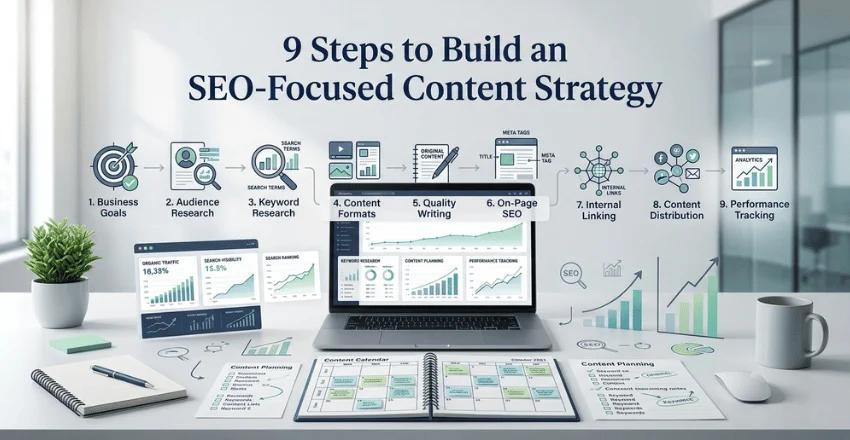
1. Define the business outcome
Start with the result your organization wants from content. That result could be qualified traffic, product signups, leads, newsletter subscriptions, or customer retention. A clear objective helps you judge whether a topic deserves resources.
Avoid making rankings the only goal. A page ranking first but attracting the wrong audience may produce little business value. Connect search visibility with an outcome that matters to your organization.
2. Research your U.S. audience
U.S. audiences are broad, so avoid treating every American searcher as identical. Consider industry, state differences, customer knowledge, budget, and buying stage. These factors affect both topic selection and writing style.
Review customer questions, sales conversations, support tickets, Search Console data, and community discussions. Look for repeated problems that your business can answer credibly. These sources can reveal opportunities that keyword tools miss.
3. Build topics around real search demand
Keyword research helps confirm how people describe their needs. Start with one main query, then identify related questions and supporting terms—group closely related searches instead of creating separate thin articles for every variation.
Prioritize topics where your site has something useful to contribute. Search volume alone should not decide your editorial calendar. Audience and business relevance should carry more weight.
Writfy’s existing SEO marketing campaign checklist can support broader campaign planning around keyword research and on-page work. It already covers general campaign fundamentals. Your new topic cluster can focus more deeply on the content process itself.
4. Map each topic to the right format
Not every keyword deserves a standard blog post. Some searches need a checklist, comparison table, tutorial, definition, template, or short answer. Choosing the right format helps readers reach the information faster.
Study the strongest pages already ranking for your target query. Look for common structures, recurring questions, and missing explanations. Then create a page that satisfies familiar expectations while adding something useful competitors lack.
5. Create content that earns attention
Strong SEO content should solve a specific problem rather than repeat existing search results. Add practical examples, clearer explanations, original frameworks, or useful comparisons. Every section should have a reason to exist.
Google specifically encourages substantial, original information rather than simple rewrites of other sources. It also recommends clear sourcing and trustworthy authorship information. Those principles make content more useful even before ranking considerations enter the discussion.
Keep sentences direct and paragraphs focused. Use headings that tell readers what each section contains. Tables and lists can reduce effort when readers need to compare or scan information.
6. Optimize the page without stuffing keywords
On-page optimization should clarify the topic rather than make the copy repetitive. Use the main query naturally in the title, introduction, one relevant heading, and supporting metadata. Related language can carry the rest of the article.
Write descriptive headings and a useful meta description. Keep the URL short and readable. Add descriptive image text when images provide meaningful information.
Technical foundations such as metadata, indexing, and site structure help search engines access pages after you complete your editorial work.
7. Connect related pages with internal links
Internal links help readers continue exploring connected topics. They also show relationships among pages on your site. Use descriptive anchor text that explains what the destination contains.
Build clusters around topics your audience repeatedly needs. A broad guide can link to detailed supporting resources, while those resources can link back to the central guide. This creates clearer navigation than publishing isolated posts.
Small businesses can also connect SEO work with a broader publishing schedule. Writfy’s practical content plan for small businesses provides a natural companion for readers building a consistent online presence.
8. Distribute content beyond Google
Publishing is the start of distribution, not the finish. Share useful resources through email, social channels, industry communities, and relevant outreach. Different channels can introduce the same resource to different audience segments.
Do not copy the entire article onto every platform. Adapt the strongest insight into a short post, email section, graphic, or discussion prompt. Each format can point interested users toward the deeper resource.
This approach also reduces dependence on one traffic source. Current content strategy guidance increasingly recommends planning for multiple discovery paths. Organic search can remain important without carrying the entire distribution strategy.
9. Measure business results and update useful pages
Measure more than impressions and keyword positions. Track organic clicks, engaged visits, conversions, assisted conversions, leads, and other actions tied to your objective. Different pages may contribute at different stages of the customer journey.
Review important content regularly instead of automatically changing publication dates. Update statistics, examples, links, screenshots, and advice when the underlying information changes. Google warns against changing dates merely to make unchanged pages appear fresh.
Performance data should also shape future topics. Strong engagement may reveal areas worth expanding. Weak results can signal an intent mismatch, poor positioning, insufficient authority, or a distribution problem.
A Simple Content Marketing SEO Workflow
A repeatable workflow prevents teams from treating optimization as a final editing task. Research, writing, optimization, and measurement should connect from the beginning. The sequence below works for many small and midsize teams.
- Choose one measurable business objective.
- Research audience problems and search behavior.
- Select one primary query and supporting themes.
- Confirm the dominant search intent.
- Review competing results and identify content gaps.
- Outline the page around the reader’s questions.
- Draft an original, useful answer.
- Add on-page optimization and internal links.
- Publish and distribute across relevant channels.
- Measure outcomes and improve the page when needed.
This workflow also makes responsibilities easier to assign. Researchers can validate demand, writers can focus on usefulness, and SEO specialists can review discoverability. Editors can then protect clarity, accuracy, and brand standards.
Common Mistakes That Limit Search Performance
Publishing many loosely related articles can dilute editorial focus. Creating several pages for nearly identical queries can also create internal competition. Build a clear topic map before increasing publishing volume.
Another mistake is treating a keyword count as proof of optimization. Repetition does not compensate for weak intent matching or shallow answers. Search systems can understand related terms and context without constant exact-match wording.
Teams also overlook older pages while chasing new topics. Existing content may already have authority, links, and search impressions. Improving a promising page can sometimes produce more value than starting from zero.
Finally, avoid content that only summarizes competitors. Google’s people-first guidance encourages original information and meaningful added value. Give readers a reason to prefer your page rather than another version of the same answer.
What Should U.S. Businesses Measure?
Organic traffic remains useful, but it should sit beside business metrics. Track how search visitors behave after landing on a page. Their next actions reveal whether visibility is attracting the right audience.
Useful measurements include the items below.
- Search impressions and organic clicks
- Click-through rate from search results
- Engaged sessions
- Newsletter or account signups
- Lead form submissions
- Assisted conversions
- Revenue influenced by organic content
- Links earned from reputable sites
- Performance changes after updates
Choose metrics based on each page’s role. An educational article may assist later conversions rather than generate immediate sales. A comparison page may sit much closer to a purchase decision.
FAQ
What is content marketing SEO?
Content marketing SEO is the practice of creating useful, audience-focused material while applying search research and on-page optimization. It connects content creation with discoverability instead of treating them as separate activities. The aim is qualified visibility that supports measurable audience or business goals.
Is SEO still important for content marketing in 2026?
Yes, search remains an important discovery channel for many businesses. Current strategies also account for AI-powered discovery, social platforms, email, and other sources. The strongest approach uses SEO alongside those channels rather than depending on one source alone.
How often should SEO content be updated?
No universal update schedule fits every page. Review important content when information, search intent, products, regulations, statistics, or competing results change. Update because the page needs improvement, not because a calendar says every article must change.
Does every blog post need keyword research?
Keyword research is helpful when organic search is an important discovery path. Some content exists for customers, email subscribers, brand communication, or thought leadership instead. Start with the audience and purpose, then decide whether search data can strengthen the piece.
How long should SEO content be?
There is no preferred Google word count for ranking. A page should be long enough to satisfy its purpose without padding. Google explicitly says creators should not write to an arbitrary length because they believe search systems prefer it.
Build a Search Strategy Around Useful Content
Effective content marketing SEO begins with a simple principle: help the right audience solve a real problem. Search research identifies demand, while useful content earns attention after the visitor arrives. Optimization then makes that value easier for search systems and readers to understand.
For Writfy, the strongest opportunity is connecting existing SEO resources with more focused topic clusters. Each new article should answer a distinct search need and link naturally to related guidance. That approach can build deeper coverage without creating unnecessary duplicate pages.
Start with one audience problem and one measurable goal. Create the best resource your site can credibly provide for that need. Then measure what happens and use the results to improve the next page.
