

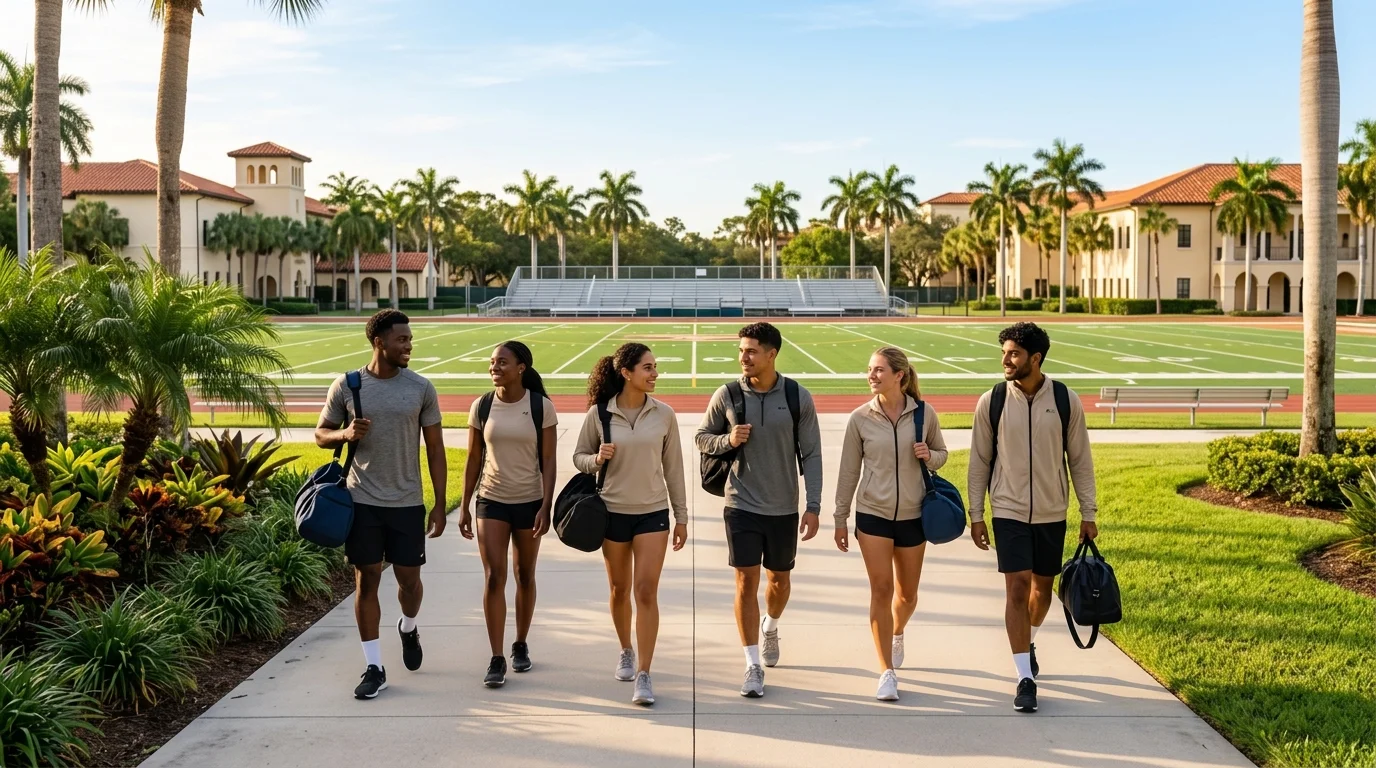
Florida currently has 13 schools competing in NCAA Division II athletics. D2 colleges in Florida include private universities, liberal arts colleges, and one historically Black university. Most compete in the Sunshine State Conference, while two belong to other Division II conferences.
Division II can suit athletes who want serious competition without choosing a Division I program. The NCAA describes D2 as a model balancing athletics, academics, and campus involvement. Athletic aid is available, although many awards cover only part of a student’s costs. For more college guidance, browse the education articles on Writfy.
Quick answer: Florida has 13 colleges currently competing in NCAA Division II athletics in 2026. Eleven belong to the Sunshine State Conference. Flagler competes in the Peach Belt Conference, while Edward Waters competes in the SIAC. West Florida began Division I competition in fall 2026 and is reclassifying.
Florida Division II Colleges at a Glance
| School | City | Current Conference |
|---|---|---|
| Barry University | Miami Shores | Sunshine State Conference |
| Eckerd College | St. Petersburg | Sunshine State Conference |
| Embry-Riddle Aeronautical University | Daytona Beach | Sunshine State Conference |
| Edward Waters University | Jacksonville | Southern Intercollegiate Athletic Conference |
| Flagler College | St. Augustine | Peach Belt Conference |
| Florida Institute of Technology | Melbourne | Sunshine State Conference |
| Florida Southern College | Lakeland | Sunshine State Conference |
| Lynn University | Boca Raton | Sunshine State Conference |
| Nova Southeastern University | Fort Lauderdale | Sunshine State Conference |
| Palm Beach Atlantic University | West Palm Beach | Sunshine State Conference |
| Rollins College | Winter Park | Sunshine State Conference |
| Saint Leo University | Saint Leo | Sunshine State Conference |
| University of Tampa | Tampa | Sunshine State Conference |
The Sunshine State Conference dominates Florida’s Division II presence. Its 2026 competition includes 11 Florida institutions across sports such as baseball and soccer. Current conference standings confirm those schools remain active members.
Flagler College currently competes in the Peach Belt Conference. The college has announced plans to join the Sunshine State Conference for 2027-28. That change will bring another Florida program into the state’s largest Division II conference.
Complete List of D2 Colleges in Florida
Barry University
Barry University is located in Miami Shores, near the Miami metropolitan area. Its teams compete as the Buccaneers in the Sunshine State Conference. Students can combine college athletics with programs across business, health sciences, education, and other fields.
Barry may appeal to athletes who want access to a major urban area. Its location differs sharply from Florida’s smaller college towns. Prospective athletes should confirm whether their sport is sponsored before contacting coaches.
Eckerd College
Eckerd College sits in St. Petersburg on Florida’s Gulf Coast. The Tritons compete in the Sunshine State Conference. The college is known for a smaller campus environment and a strong coastal identity.
Its location can attract students who want a liberal arts setting near Tampa Bay. Athletes should compare academic programs alongside each team’s competitive level. Recruiting needs can also change significantly from one season to another.
Embry-Riddle Aeronautical University
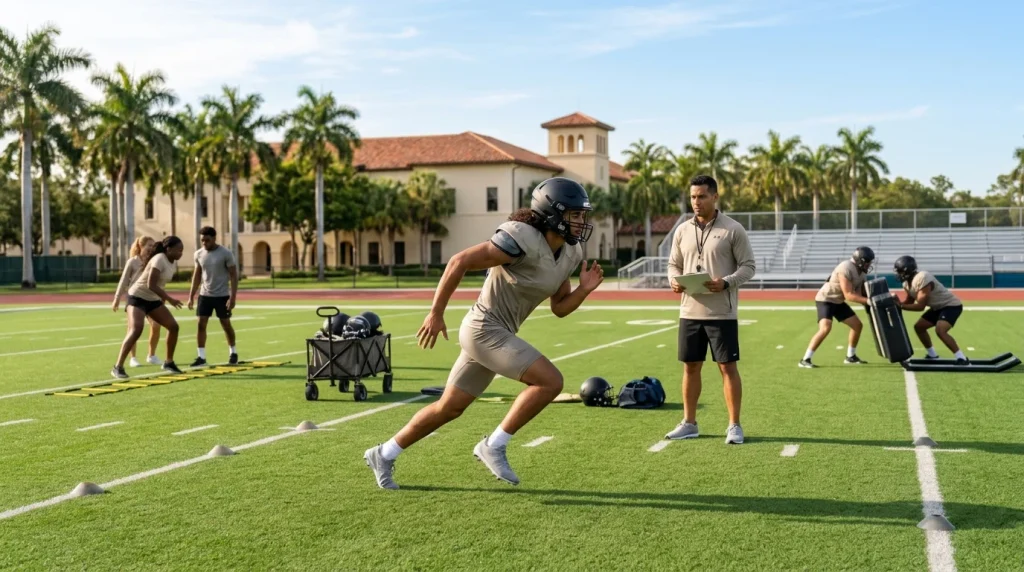
Embry-Riddle’s Daytona Beach campus competes in NCAA Division II as the Eagles. The university is especially associated with aviation, aerospace, engineering, and technical programs. Its teams compete in the Sunshine State Conference.
This combination can be useful for athletes with specific STEM or aviation goals. Academic fit should still come before an athletic label. A strong sports program cannot compensate for a poor major or financial fit.
Edward Waters University
Edward Waters University is located in Jacksonville and is a historically Black university. Its Tigers compete in the Southern Intercollegiate Athletic Conference. The school became a full NCAA Division II member in recent years.
Edward Waters is especially notable for students seeking an HBCU experience in Florida. It also differs from many Florida Division II institutions because it sponsors football. That makes it an important option for athletes researching D2 football in the state.
Flagler College
Flagler College is based in historic St. Augustine. The Saints currently compete in the Peach Belt Conference. Flagler will move to the Sunshine State Conference beginning with the 2027-28 academic year.
The school offers a smaller private-college setting near Florida’s Atlantic coast. Prospective recruits should consider the coming conference change during their research. Conference membership can affect schedules, travel, rivalries, and recruiting priorities.
Florida Institute of Technology
Florida Institute of Technology, commonly called Florida Tech, is located in Melbourne. The Panthers compete in the Sunshine State Conference. The university has a strong academic focus on science, engineering, technology, and aviation-related fields.
Florida Tech can suit athletes interested in technical careers and competitive college sports. The school no longer sponsors varsity football. Students should check its athletics website for the current list of sponsored teams.
Florida Southern College
Florida Southern College is located in Lakeland between Tampa and Orlando. The Moccasins compete in the Sunshine State Conference. The college offers a traditional residential campus with numerous varsity sports.
Its central location can make travel convenient across much of Florida. Students should examine the academic department supporting their intended major. They should also compare total financial aid rather than athletic money alone.
Lynn University
Lynn University is a private university in Boca Raton. Its Fighting Knights compete in the Sunshine State Conference. The school’s South Florida location places students near a large business and employment market.
Lynn can suit students who prefer a smaller university near a major metropolitan region. Athletic opportunities differ by sport and recruiting class. Direct coach communication remains essential before making assumptions about roster availability.
Nova Southeastern University
Nova Southeastern University is located in the Fort Lauderdale area. The Sharks compete in the Sunshine State Conference. NSU offers undergraduate programs alongside extensive graduate and professional education.
That academic breadth can attract students considering long-term professional study. Athletic success should be evaluated alongside cost, program quality, and campus culture. Prospective athletes should also ask coaches how aid packages are constructed.
Palm Beach Atlantic University
Palm Beach Atlantic University is located in West Palm Beach. The Sailfish compete in the Sunshine State Conference. It is a private Christian institution with a coastal urban setting.
Students considering PBA should decide whether its religious environment matches their preferences. Athletes should also investigate their exact sport’s roster and scholarship situation. Division II membership does not mean every sport receives identical funding.
Rollins College
Rollins College is located in Winter Park, near Orlando. Its teams, known as the Tars, compete in the Sunshine State Conference. Rollins has a small-college atmosphere with a strong liberal arts tradition.
The location provides access to a major metropolitan area without a large university campus. That combination may appeal to students wanting smaller classes and competitive athletics. Cost and financial aid deserve close attention at any private college.
Saint Leo University
Saint Leo University is based in Saint Leo, north of Tampa. The Lions compete in the Sunshine State Conference. It is a Catholic university offering both campus-based and other educational programs.
Athletes can compare Saint Leo with nearby Florida programs without leaving the same general region. The best choice depends on the sport, major, aid package, and campus experience. No single ranking can replace those individual comparisons.
University of Tampa
The University of Tampa is located near downtown Tampa. The Spartans compete in the Sunshine State Conference. Its urban setting creates a different experience from Florida’s smaller residential college towns.
Tampa offers many varsity sports but does not sponsor football. Students seeking another sport can find strong Division II competition there. They should confirm current offerings directly through the university before beginning recruitment conversations.
What Happened to the University of West Florida?
Older lists often say Florida has 14 Division II institutions. That count included the University of West Florida in Pensacola. The situation changed during 2026, making older articles misleading for current applicants.
UWF announced its move from Division II to Division I in April 2026. The school began competing in the Atlantic Sun Conference during fall 2026. Football joined the United Athletic Conference as part of the same transition.
The NCAA directory currently labels UWF as a Division II reclassifying member moving toward Division I-FCS status. Its teams are already competing at the Division I level during that process. Full NCAA Division I postseason eligibility is expected after the reclassification period ends.
How Division II Athletic Scholarships Work
NCAA Division II schools can award athletic scholarships. The division commonly uses partial awards rather than assuming every recruited athlete receives full funding. Students often combine athletic money with academic, need-based, or other financial aid.
A scholarship offer should be evaluated as part of the full financial package. Ask what portion is athletic aid and whether it renews each year. You should also ask whether academic awards can be combined with athletic assistance.
Never compare schools using the scholarship headline alone. Compare the final annual cost after every grant and scholarship. Housing, meals, travel, fees, and personal expenses can change the real price considerably.
D2 Football Schools in Florida
Football players have fewer Florida Division II choices than athletes in many other sports. Edward Waters is the clearest current in-state D2 football option. West Florida previously competed in Division II football but started Division I competition in 2026.
This distinction explains why some searches produce conflicting school counts. A general Florida D2 list and a D2 football list are not the same thing. Many Division II institutions in Florida do not sponsor football at all.
Athletes should search by sport before building a recruiting list. A school’s NCAA classification does not guarantee that it offers your event. Current rosters and athletics websites provide more useful recruiting information.
How to Choose the Right Florida D2 School
Start with the academic program you want to study. A college must support your goals even if an injury ends your athletic career. Check majors, accreditation, internships, graduation outcomes, and academic support such as study habits for college students.
Next, compare the athletic opportunity realistically. Look at roster size, returning players, coaching stability, and your likely position within the program. Ask coaches direct questions about recruiting priorities for your graduation year.
Cost should be reviewed after all available aid appears. Compare net price rather than published tuition whenever possible. A larger scholarship at an expensive school can still cost more overall.
Campus setting should be your final major filter. Florida options range from Miami-area universities to smaller coastal and inland communities. Visit campuses when possible before making a binding enrollment decision.
D2 Versus D1 and D3
| Factor | Division I | Division II | Division III |
|---|---|---|---|
| Athletic scholarships | Available | Available, often partial | No athletic scholarships |
| Athletic scale | Generally larger | Competitive, regional focus | Competitive, academics-focused model |
| Recruiting | Often highly intensive | Competitive | Competitive but no athletic aid |
| Florida options | Numerous | 13 current competitors | Limited compared with many states |
Division II is not automatically easier than Division I. High-level D2 athletes can be exceptionally accomplished competitors. The better distinction concerns program scale, scholarships, schedules, and each school’s overall athletics model.
Division III also differs because schools cannot award athletic scholarships. Academic and need-based aid can still make a D3 school affordable. Students should compare total packages instead of choosing a division label first.
Frequently Asked Questions
How many D2 colleges in Florida are there in 2026?
Florida has 13 institutions currently competing at the NCAA Division II level. That count reflects West Florida’s move into Division I competition during fall 2026. Some older pages still show 14 because they include UWF.
Which conference has the most Florida Division II schools?
The Sunshine State Conference has the largest concentration in Florida. Eleven current Florida D2 institutions compete there. Flagler is scheduled to join that conference for the 2027-28 academic year.
Can Division II colleges give athletic scholarships?
Yes, NCAA Division II schools can provide athletic aid. Many athletes receive partial scholarships rather than full athletic awards. Academic and need-based aid can often form part of the overall package.
Are there D2 football colleges in Florida?
Edward Waters University currently provides a Division II football option in Florida. West Florida previously played D2 football but began Division I competition in fall 2026. Most other Florida Division II schools do not sponsor varsity football.
Is Division II a good choice for student-athletes?
Division II can be an excellent fit for students seeking competitive athletics and academic balance. The NCAA emphasizes regional competition and a more integrated student experience. Your personal fit still depends on academics, finances, coaching, and playing opportunities.
The Bottom Line
Florida gives prospective Division II athletes a varied group of colleges across several regions. The strongest choice depends on much more than conference membership. Your major, net cost, roster opportunity, and preferred campus environment should lead the decision.
Build a shortlist of three to six programs that match those priorities. Then verify each sport through the school’s current athletics site and contact the coaching staff. That approach is more reliable than choosing a school from rankings alone.
