

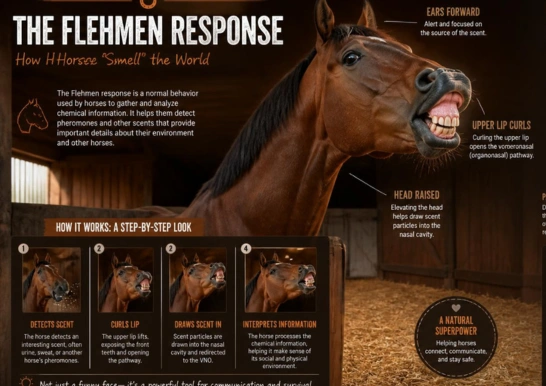
The flehmen response is the lip-curling, open-mouth expression you may see in cats, horses, and other mammals. It helps animals examine chemical cues that ordinary sniffing may not capture as effectively. The face can resemble disgust, but the animal is usually gathering scent information.
| Question | Quick answer |
| What is happening? | The animal changes its lip and head position to sample chemical cues. |
| Which organ is involved? | The vomeronasal organ, also called Jacobson’s organ. |
| What triggers it? | Pheromones, urine, secretions, unfamiliar odors, and other interesting chemical signals. |
| Which animals show it? | Cats, horses, big cats, goats, cattle, deer, giraffes, and some dogs. |
| Is it usually normal? | Yes, when it is brief and follows scent investigation. |
| When should you worry? | Seek veterinary help if mouth opening is accompanied by breathing trouble, pain, collapse, or other abnormal signs. |
Key takeaways
- The lip curl is usually a scent-sampling behavior, not a human-like expression of disgust.
- Jacobson’s organ helps many animals analyze chemical signals linked with social and reproductive information.
- Cats and horses show obvious versions, while dogs may display a subtler form.
- Context matters because open-mouth breathing or repeated lip curling can sometimes signal illness or pain.
Animals curl the upper lip and briefly open the mouth to direct scent chemicals toward the vomeronasal organ. Also called Jacobson’s organ, it helps analyze cues tied to reproduction, identity, territory, and social information. The expression can look disgusted, but it usually shows focused scent investigation.
What the Flehmen Response Means

This reaction usually follows close investigation of an interesting smell. The animal may lift its head, curl its upper lip, and pause briefly. Cats may gape slightly, while horses often raise their noses and expose their front teeth.
The Flehmen response does not automatically signal disgust, anger, or aggression. In cats, veterinarians describe it as a normal scent-processing behavior. In horses, it commonly appears around urine, reproductive odors, unfamiliar tastes, or other strong scents.
How Jacobson’s Organ Works
The vomeronasal organ, or Jacobson’s organ, is a specialized chemosensory structure near the nasal cavity. Its exact anatomy varies by species. In many animals, ducts help move dissolved chemical cues toward sensory tissue inside the organ.
The lip curl changes airflow and pressure around these passages. That movement can improve contact between scent molecules and vomeronasal receptors. Signals then reach brain areas involved with instinctive social and reproductive behavior.
The system is not a simple second nose. Research indicates the main olfactory system and vomeronasal system can share chemical-sensing tasks. That overlap matters because not every social odor depends on one pathway.
Why Animals Use This Scent-Sampling Behavior
Chemical signals can carry information that animals cannot obtain from vision alone. These cues may reveal reproductive status, identity, territorial marking, or recent activity. Sampling them closely can help an animal decide what deserves further attention.
Breeding behavior is one common context, but it is not the only one. Stallions often investigate mare urine, while cats may inspect laundry, marking sites, or anal-gland odors. Females, geldings, young animals, and nonbreeding adults can also show the same posture.
Which Animals Show the Lip Curl?
The behavior appears across several mammal groups, especially felids and hoofed mammals. Cats and horses are among the easiest domestic examples to recognize. Big cats, goats, cattle, deer, giraffes, and other species also use comparable scent-sampling postures.
| Animal | Common context | Typical visible clue |
| Domestic cats | Urine, laundry, facial pheromones, unfamiliar animal odors | Mouth slightly open, upper lip raised, focused pause |
| Horses | Urine, reproductive odors, new tastes, strong environmental scents | Head raised, neck extended, upper lip curled high |
| Lions and tigers | Scent marks and reproductive signals | Pronounced grimace with exposed teeth |
| Goats, cattle, and deer | Social and reproductive chemical cues | Raised lip and brief scent-focused posture |
| Giraffes | Especially reproductive assessment | Head raised after direct scent investigation |
| Dogs | Interesting social scents | Subtle upper-lip movement, sometimes with teeth chattering |
Species differ because their mouth and nasal anatomy differ. Horses route vomeronasal access differently from cats, so the mechanics are not identical. Dogs may show such a small lip movement that owners miss the behavior entirely.
Cat owners can pair behavior observation with Writfy’s cat window hammock guide for indoor enrichment ideas. Horse owners can also review Writfy’s horse stable supplies guide. Those pages cover care topics rather than scent biology, but they support broader pet and horse ownership needs.
How It Differs From Panting, Snarling, or Pain
A normal scent-sampling episode is brief and follows sniffing or licking. The animal usually returns to normal without effort or distress. Persistent open-mouth breathing, coughing, collapse, or abnormal gum color needs prompt veterinary attention in cats.
Horses also need context because lip curling can occur alongside abdominal discomfort. Repeated curling with pawing, rolling, flank watching, or reduced manure can accompany colic. Contact a veterinarian when the behavior appears with pain, distress, or other abnormal signs.
| What you see | Likely meaning | Useful next step |
| Brief lip curl after sniffing | Normal chemical investigation | Observe and let the animal finish |
| Cat keeps breathing with mouth open | Possible respiratory or heat-related problem | Contact a veterinarian promptly |
| Cat hisses with ears back and tense posture | Defensive or fearful behavior | Give space and assess the trigger |
| Horse repeatedly curls its lip with colic signs | Possible abdominal pain | Call the veterinarian |
Common Misconceptions About the Lip Curl
The first misconception is that the animal thinks something smells bad. Human faces encourage that interpretation, but the posture serves chemical investigation. A cat can make the face after smelling something interesting rather than something unpleasant.
The second misconception is that only males perform the behavior. Males may show it often during reproductive assessment, especially stallions. Females and younger animals can also use the same sensory pathway in other contexts.
The third misconception is that every species performs the behavior the same way. Mouth structure, nasal passages, and vomeronasal anatomy differ across mammals. The shared purpose is chemical sampling, while the exact movements can look different.
What to Remember the Next Time You See That Face
The strange grimace is usually an information-gathering tool rather than an emotional reaction. If you watch what happened first, you’ll often understand the reaction. That context explains the behavior better than the facial expression alone.
If the animal stays comfortable, brief lip curling is usually something to observe rather than stop. If distress or abnormal breathing appears, contact a veterinarian instead of assuming scent investigation. For more pet topics, browse Writfy’s Pets section and keep learning from behavior in context.
Frequently Asked Questions
Why do cats open their mouths after smelling something?
Cats often open their mouths to direct scent molecules toward Jacobson’s organ. The posture helps them examine pheromones and other interesting chemical cues. It can follow sniffing urine, laundry, another animal, or a marked surface.
Is the flehmen response normal?
Yes, it is usually normal when the animal appears relaxed, and the episode is brief. The behavior commonly follows a specific sniffing event. Concern increases when mouth opening continues or appears with breathing trouble, pain, weakness, or other symptoms.
Do dogs use this behavior too?
Dogs can show a related scent-sampling reaction, but it is usually less dramatic. Their upper-lip movement may be slight, and they may chatter their teeth. Owners notice it less often than the obvious expressions seen in cats or horses.
Can humans do the same thing?
Humans do not show a recognized version of this animal lip-curling behavior. Scientific sources differ about the significance of vestigial vomeronasal structures in people. The well-described animal mechanism should not be treated as a proven human sensory system.
How long does the posture last?
The posture is usually brief and often lasts only several seconds. Duration varies with species, stimulus, and individual behavior. Repeated or prolonged episodes deserve more attention when they occur with other abnormal signs.
